


I Tested NEW MiniMax-M3.1-Flash on 27 Coding Prompts[22]
Coding tests made after the 2026-10-19 release. Sponsorship status unknown.
This model is not available on Effect Video yet. The page covers it for reference.
MiniMax 3.1 Flash is a multimodal LLM priced at $0.15 and $0.60 per 1M tokens. Specs, limits, rivals, and how to use it to write AI video prompts.
By Effect Video TeamUpdated
MiniMax M3.1 Flash is a language model. It reads text, images and video and answers in text, so it does not render clips, and Effect Video does not offer it. For a MiniMax video model on this site, see MiniMax H3.
MiniMax M3.1 Flash is a fast, low-priced language model that MiniMax released on 2026-10-19. People also search for it as MiniMax 3.1 Flash or minimax m3 1 flash, and MiniMax's own spelling is M3.1 Flash. This page gathers what MiniMax and independent trackers have published about it. It then looks at where a language model fits in AI video work, such as writing prompts, splitting an idea into shots and reading a reference clip.
We did not run the model ourselves. Every figure below comes from the sources listed at the end, checked on 2026-10-22, and numbers that differ between sources are shown side by side.
MiniMax presents M3.1 Flash as a next-generation Flash model with gains in agentic tasks, coding, computer use and cybersecurity. The launch post also says online inference became nearly three times faster and usage cost for agentic tasks fell by 70%. Flash is the efficient tier. MiniMax says a Pro model that pushes intelligence further will arrive later, with no date.
An earlier version ran anonymously under the name Space Bunny, which MiniMax says processed more than 200 trillion tokens. OpenRouter, one of the platforms where it appeared, says Space Bunny was its top model for 10 straight days at 56.7 trillion tokens (OpenRouter on X).
A preview named M3.1-Flash-Preview debuted in MiniMax Code on 2026-09-28 (changelog), so creator videos from late September and early October cover the preview build and not the final model. The released model is available through the MiniMax API, the M Plan subscription and the MiniMax Code desktop app.
MiniMax makes several kinds of model, and two of them get mixed up. M3.1 Flash writes text. MiniMax H3 makes video, and it is the one you can use on Effect Video. The table sets them side by side.
| Item | MiniMax M3.1 Flash | MiniMax H3 |
|---|---|---|
| What it makes | Text: answers, plans, code and tool calls. It reads images and video but does not render them. | Video clips, from a text prompt, images, first and last frames or multimodal references (MiniMax Model List). |
| Output | Text. | 768P or 2K video, 4 to 15 seconds per clip on the MiniMax API (Model List). |
| MiniMax API price | $0.15 input, $0.60 output and $0.015 cached input per 1M tokens (pricing). | $0.08 per second at 768P and $0.13 per second at 2K for the output video. Input video and images beyond the first five are billed on top (pricing). |
| On Effect Video | Not offered. | Yes. MiniMax H3 on Effect Video shows the credits before you generate. |
Prices are MiniMax API list prices in USD. Effect Video prices its video models in credits.
The table lists what MiniMax's own pages say, each with its source. Prices are list prices on the MiniMax API.
| Item | What MiniMax states | Source |
|---|---|---|
| Release | General release on 2026-10-19. It followed M3.1-Flash-Preview, which debuted in MiniMax Code on 2026-09-28. | Launch post, release notes, MiniMax Code changelog |
| API model name | MiniMax-M3.1-Flash | API docs |
| Context window | 1,000,000 tokens. | API docs |
| Inputs and output | Text, images and video in, text out. Image and video handling in MiniMax Code is tool-assisted and separate from native image or video generation. | API docs, MiniMax Agent page |
| Reasoning | Always on. Five effort levels: low, medium, high, xhigh and max, with max as the default. Turning reasoning off returns an error. | API docs |
| API formats | Anthropic-compatible (recommended) and OpenAI-compatible endpoints. | API docs |
| Price per 1M tokens | $0.15 input, $0.60 output, $0.015 cached input. One flat rate; the pricing page shows no tier by context length for this model. | Pricing overview, launch post |
| Speed (MiniMax figure) | Output speeds can reach 200+ tokens per second in everyday use, with a median above 170. Online inference is described as nearly three times faster than the previous generation. | Launch post |
| Cost claim (MiniMax figure) | 70% lower overall usage cost on agentic tasks than the previous generation. MiniMax says this is not an API unit-price comparison. | Launch post, MiniMax Agent page |
| Benchmarks MiniMax reports | BankerToolBench 76.2, DeepSWE v1.1 73.7%, OSWorld V2 61.7, Agents' Last Exam 29.6 and CyberGym 82%. All are MiniMax's own figures for coding, agent and computer-use tasks. | Launch post |
| Weights and license | The launch post says weights will be released later, with no date and no license named. The API docs and release notes describe the model as open-weight. A MiniMax post on X gives 2026-10-23. | Launch post, API docs, MiniMax on X |
| Parameter count | Not stated. | Absent from the launch post, the API docs and the Model List. |
Prices are MiniMax API list prices in USD. Plans such as M Plan and free periods are not covered.
On weights, the launch post is short.
"Model weights will be released later."
MiniMax, launch post, 2026-10-19
The API docs and release notes call the model open-weight, and a MiniMax post on X gives 2026-10-23 for the release. A screenshot of that post on r/LocalLLaMA reads "Model weights will arrive on Oct 23", and VentureBeat and The Decoder report the same date. When we checked on 2026-10-22, the MiniMaxAI organization on Hugging Face listed no M3.1 repository, no license was named and MiniMax had published no parameter count. Open weights are planned, not delivered.
Two models come up most often next to it: Google's Gemini 3.8 Flash and DeepSeek's V4.1 Flash. The table uses only the numbers each vendor prints on its own price and model pages.
| Item | MiniMax M3.1 Flash | Gemini 3.8 Flash | DeepSeek V4.1 Flash |
|---|---|---|---|
| API model name | MiniMax-M3.1-Flash | gemini-3.8-flash | deepseek-flash, served by DeepSeek-V4.1-Flash-1017 |
| Input per 1M tokens | $0.15 | $0.75 through 2026-12-31, then $1.50 | $0.15 off-peak, $0.30 at peak (cache miss) |
| Output per 1M tokens | $0.60 | $3.75 through 2026-12-31, then $7.50, thinking tokens included | $0.60 off-peak, $1.20 at peak |
| Cached input per 1M tokens | $0.015 | $0.075 through 2026-12-31, then $0.15, plus an hourly storage fee | $0.003 off-peak, $0.006 at peak (cache hit) |
| Context window | 1,000,000 tokens | 1,048,576 input tokens | 1M tokens |
| Maximum output | Not stated in the MiniMax docs | 65,536 tokens | 384K tokens |
| Input types | Text, images and video | Text, image, video, audio and PDF | Text, with vision listed as supported |
| Thinking | Always on, effort from low to max | Supported at low, medium and high; minimal is not supported | Thinking (default) and non-thinking modes |
Sources: MiniMax pricing and API docs, Google Gemini pricing and Google Gemini 3.8 Flash page, DeepSeek pricing. DeepSeek peak hours are 01:00 to 04:00 and 06:00 to 10:00 UTC on weekdays, excluding Chinese public holidays; off-peak is half the peak rate.
At those list prices, M3.1 Flash costs the same as DeepSeek's off-peak rate and half its peak rate. Gemini 3.8 Flash costs five times as much for input and 6.25 times as much for output until 2026-12-31, then ten times and 12.5 times as much once Google's price rises on 2027-01-01. DeepSeek's V4.1 Flash weights are already on Hugging Face with an MIT license listed, which MiniMax cannot yet match.
A low price per token does not decide the bill, because a model that thinks at length writes more tokens. VentureBeat lists about 189M output tokens for M3.1 Flash on the Artificial Analysis index run, against 324M for GLM-5.3 Flash and 334M for Gemini 3.8 Flash. The Artificial Analysis page, read on 2026-10-22, puts M3.1 Flash at 180M and calls it very verbose against a median of 99M across the models it tracks. The next table shows what Artificial Analysis reported in launch week, as relayed by VentureBeat and The Decoder.
| Measure | MiniMax M3.1 Flash | DeepSeek V4.1 Flash (1017) | Gemini 3.8 Flash |
|---|---|---|---|
| Artificial Analysis Intelligence Index | 42 on 2026-10-19; 43 on the Artificial Analysis page read on 2026-10-22 | 45 | 41 |
| Cost to run the index, per task | About $0.22 | About $0.26 | About $1.24 |
| Humanity's Last Exam | 48% | 43% | Same as M3.1 Flash, per VentureBeat |
| CritPt, physics reasoning | 22% | 24% | 18% |
| AA-Omniscience, share answered correctly | 56% | 43% | Not listed |
| AA-Omniscience, hallucination rate | 93% | Not listed | Not listed |
Artificial Analysis results as relayed by VentureBeat and The Decoder on 2026-10-19, except where a cell names another date. See the Artificial Analysis page. We did not rerun any of these.
DeepSeek V4.1 Flash leads on the index and on CritPt. M3.1 Flash is ahead on Humanity's Last Exam and on the share of factual questions answered correctly, and it costs far less per task than Gemini 3.8 Flash. VentureBeat adds MiniMax's own figures, which it labels as vendor numbers: 62.2 on Automation-Bench against 60.5 for DeepSeek, and 73.7% on DeepSWE against 77% for DeepSeek.
The weak point in the data is hallucination. Artificial Analysis gave M3.1 Flash a 93% hallucination rate on AA-Omniscience, which VentureBeat explains as the share of non-correct answers that were wrong, with no refusal and no partial answer. Its summary of the result:
"it demonstrated an exceptionally high tendency to generate incorrect answers rather than acknowledge uncertainty."
Carl Franzen, VentureBeat, 2026-10-19
On the same test the model answered 56% of questions correctly, against 43% for DeepSeek V4.1 Flash.
Launch coverage repeats MiniMax's numbers, and trackers keep updating theirs. The table lists the differences we found.
| Topic | One reading | Another reading |
|---|---|---|
| Video input | MiniMax's API docs and Agent page list text, image and video input. OpenRouter lists the same. | Artificial Analysis lists text and image input. VentureBeat and The Decoder also name text and image only. |
| Output speed | MiniMax: output can reach 200+ tokens per second, with a median above 170. OpenRouter said throughput rose from 70 to 100 tokens per second during the stealth phase. | The Artificial Analysis page shows 92.8 tokens per second and describes the model as slower than average. |
| Intelligence Index | 42, in VentureBeat and The Decoder on 2026-10-19. | 43, on the Artificial Analysis page read on 2026-10-22. |
| Saving against M3 | MiniMax: 70% lower overall usage cost on agentic tasks. | Artificial Analysis, via VentureBeat: about 57% lower cost per index task ($0.51 to $0.22). The per-token price is half of M3's $0.30 and $1.20 for inputs up to 512k tokens. |
| AutomationBench-AA | 62.2, on the MiniMax Agent page and in VentureBeat's MiniMax-reported figures. | 72.5%, in an OpenRouter thread that quotes MiniMax. |
| Weights | Launch post: later, no date. API docs and release notes: open-weight. MiniMax on X: 2026-10-23. | VentureBeat and The Decoder: planned for 2026-10-23. Artificial Analysis lists the model as proprietary. The MiniMaxAI page on Hugging Face showed no M3.1 repository on 2026-10-22. |
Sources are linked in the References below. We did not decide between the readings; plan around the cautious one.
A language model sits before the video model in the workflow and does not replace it. Everything in this section is how we would use it. We have not tested M3.1 Flash on any of these jobs, and we found no creator test that did.
The input list is the useful part. MiniMax says M3.1 Flash takes images and video as input and answers in text. In MiniMax Code, together with code and image-processing tools, MiniMax says it can handle tasks such as finding image differences, structuring charts and analyzing video shots. MiniMax describes that as
"tool-assisted image and video processing, which is different from native image or video generation."
MiniMax, M3.1 Flash page on MiniMax Agent
Five steps follow from that.
[Shot 2] At 00:03.500, the camera cuts to, and camera moves written as a move, an amplitude and a speed. The guide is written for H3 on the MiniMax API. We have not tested whether the H3 route on Effect Video follows it, so treat it as a starting point.Effect pages work differently. A template such as AI Dance or AI Hug takes photos and fixes the prompt itself, so there is no prompt for a language model to write. Where M3.1 Flash can still help is planning: picking the template that suits a photo and checking the photo requirements on the page. AI Lip Sync takes a portrait and your own audio. A language model can draft the lines you then record, and it does not make the audio.
For the generator, the examples below show the shape of a request and of the result you would paste into the generator. We wrote both by hand. They are not output from M3.1 Flash.
MiniMax H3 is the MiniMax model you can use here. MiniMax H3 takes a text prompt and shows the credits before you generate. The generator lets you pick a model, and the prompt library has prompts to adapt. For a result without writing a prompt, effect pages take a photo.
This page is assembled from the public sources listed under References. They start with MiniMax's own pages and the Gemini and DeepSeek price pages, then add independent coverage, trackers such as Artificial Analysis and OpenRouter, creator videos, posts on X and Reddit threads. Coverage and trackers are secondary sources, so their numbers are credited to them by name. We summarize, quote briefly and link to the original. All sources were read on 2026-10-22. If MiniMax publishes weights, a license or a parameter count, the page needs an update.
I Tested NEW MiniMax-M3.1-Flash on 27 Coding Prompts[22]
Coding tests made after the 2026-10-19 release. Sponsorship status unknown.
MiniMax M3.1 Flash Is Free on OpenCode: Benchmarks, Pricing and Real Costs[23]
Covers benchmarks, pricing and costs, per the video title. Made after the release. Sponsorship status unknown.
MiniMax M3.1 Flash IS REALLY GOOD! INSANELY FAST & FREE! (Fully Tested)[24]
Tests the preview build in MiniMax Code, before the general release. Sponsorship status unknown.
Minimax M3.1 Flash (Fully Tested): Okay, this MODEL is PRETTY GOOD![25]
Tests the preview build on KingBench 3, per the video description. Made before the general release. Sponsorship status unknown.
Shot 1 (0-5s): ONE Grim Reaper, full robe and scythe, stands in line at a DMV holding a paper ticket number, single subject only, exhausted posture. Shot 2 (5-10s): The reaper glances at a wall clock, sighs, and leans the scythe against the wall like an umbrella, settling in for a long wait. The viewer sees this from a low static angle, fluorescent lighting, bureaucratic misery.
High-performance sneaker commercial. Music: rhythmic hip-hop beat with sharp percussive accents. Macro shot: sneaker sole compressing on impact, dust particles exploding outward. Cut to: fabric mesh stretching and rebounding, showcasing flexibility. Transition: dissolve into abstract waveforms representing motion energy. Close-up: laces tightening in slow motion, fibers sharply defined. Camera: low-angle tracking as the sneaker lands on asphalt, sparks of dust trailing behind. Cut to: athlete sprinting through an urban night street, neon reflections on wet ground. Final shot: sneaker resting on pavement, steam rising in background. Style: high contrast lighting, dynamic motion blur, photorealistic materials, 4K.
A sweeping drone shot rises over a mist-covered mountain valley at golden hour, revealing a crystal-clear turquoise lake nestled between snow-capped peaks. Cut to a slow aerial glide over ancient terracotta rooftops of a sun-drenched Mediterranean village, waves crashing below. Cut to a birds-eye spiral descending into a dense emerald jungle waterfall, mist rising in the early morning light. Bold white serif text fades in: "Some places feel like a dream. Final cut wide drone pull-back over a vast salt flat mirror reflecting a blazing sunset sky, infinite and still. Text overlay: Go find yours. Warm, cinematic color grade. Sweeping orchestral score with soft ambient wind. Gentle male voiceover: The world is full of places that take your breath away you just have to be willing to go.
Create a seamless 9-second surreal animation blending Tokyo with giant desserts: a massive silver fork plunges into a miniature Tokyo street and lifts a strawberry shortcake slice with whipped cream, strawberries, and red glaze; cut to street level where a giant chocolate slab sits in the pavement as thick caramel pours over it and pedestrians pass by; show a bustling skyscraper avenue decorated with strawberries and whipped-cream rooftops; finally, zoom out to reveal the entire city district sitting on a giant decorated cake on a white plate as a huge fork carves out and lifts a slice of the city-cake, seamlessly returning to the aerial Tokyo view.
MiniMax M3.1 Flash: Space Performance + Bunny Speed 🚀🐰 Yes, Space Bunny - which has topped global leaderboards with 200T+ tokens - was an earlier version of M3.1 Flash. 💰Redefining…

Stealth model reveal 🐰 Space Bunny was OpenRouter’s #1 model for 10 straight days, processing 56.7T tokens! The most of any stealth model we’ve run. Space Bunny hopped off OpenRouter…
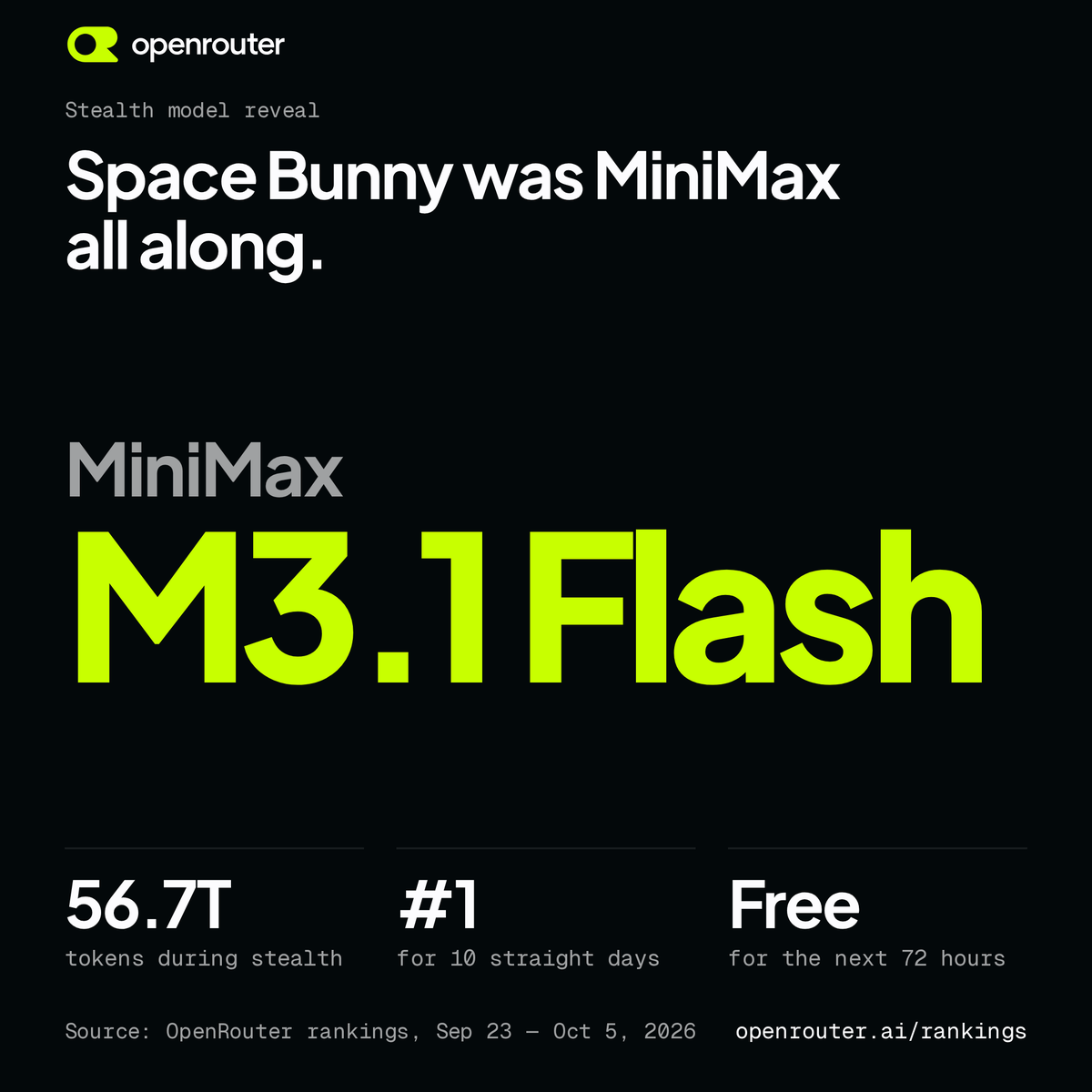
Thank you to everyone who put it through its paces. Your feedback helped MiniMax fix bugs and ship upgrades mid-stealth: - 38% faster time to first token (1.95s → 1.22s)…
It's official: Space Bunny is MiniMax-M3.1-Flash. > Oct 2: tested it free in OpenCode Zen. Fast, 12/12 finding keys in ~1M characters of context > Oct 5: tokenizer points at…
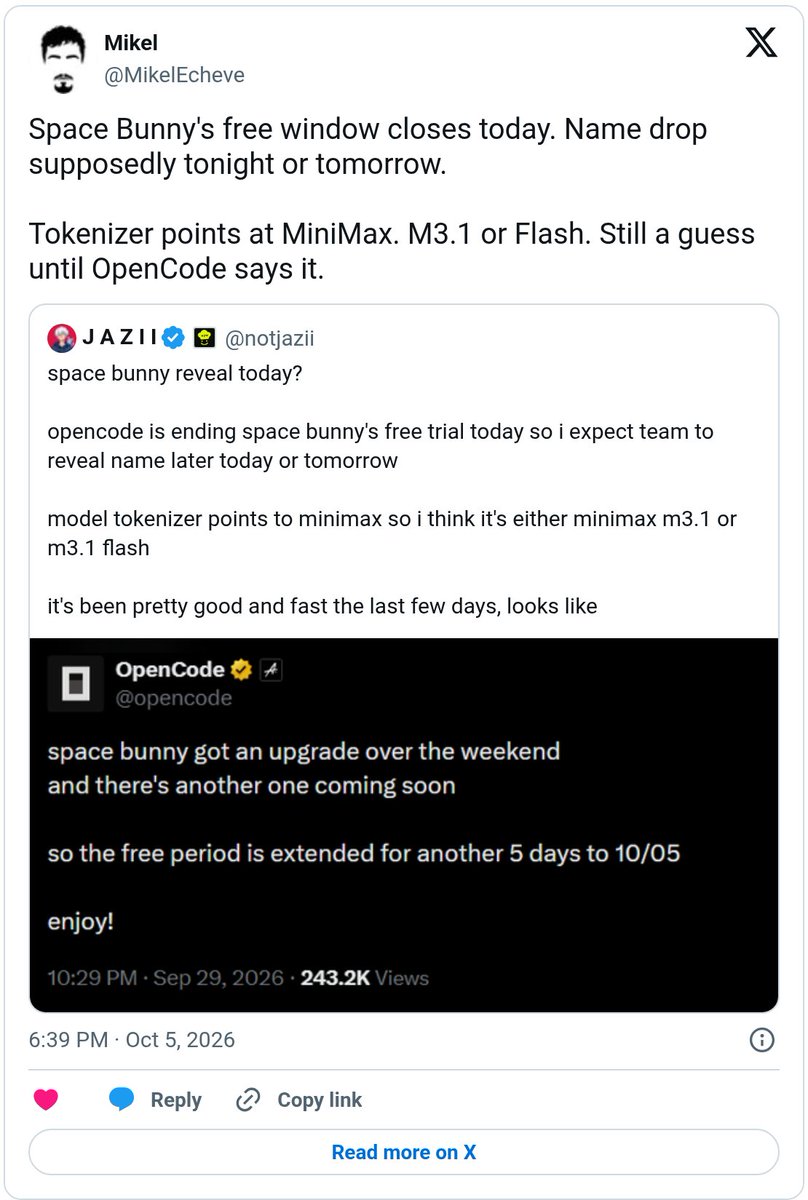
So @MiniMax_AI MiniMax-M3.1-Flash is not just Space-bunny-alpha, it's an upgrade! I tested Space-bunny a lot when it was available for free as a stealth model, including the example in this…
Links to the threads. We do not embed or quote them.
 ModelOct 22, 2026
MiniMax H3 is MiniMax's text-to-video model. On Effect Video, enter a prompt, pick 768p or 2k and a 4 to 15 second clip, and see the credits first.
 ModelOct 11, 2026
Seedance 2.0 is ByteDance's video model. On Effect Video, enter a prompt, add a photo if you like, and pick 480p to 4k and a 4 to 15 second length first.
 ModelOct 11, 2026
Veo 3.1 is Google's video model. On Effect Video, add a prompt and an optional photo for 720p to 4k clips: 4, 6 or 8 s text-only, 8 s with a photo.


